

You’re under contract. The inspection report just landed in your inbox. It is 40 pages long, contains dozens of flagged items, and now you need to decide what to ask for.
In California, the inspection contingency gives buyers a limited window to request repairs or credits from the seller.
How you use that window matters.
What you ask for, how much you request, and how you frame it can determine whether you close with thousands saved or leave money on the table.
This guide shows you how to get the right seller credit after inspection. It explains which items are defensible, what dollar amounts make sense, and which contract language mistake can cause last-minute lender issues.
Quick answer
For major systems (roof, HVAC, sewer), ask for credits equal to full replacement cost if the system is at or near end of life, or prorated cost based on remaining useful life if it has years left. Bundle all items into one closing cost credit, not a repair credit. Cap your request at your actual closing costs. See the full repair cost reference table below.
How seller credit after inspection works
A seller credit after inspection is money the seller gives you at closing, applied toward your closing costs. It is not cash, and it cannot be wired to you directly. The credit appears as a line item on your Closing Disclosure and reduces the out-of-pocket cash you bring to the table.
Credits after inspection are almost always the better choice over asking the seller to make repairs themselves, for three reasons:
- You control the quality. Seller-completed repairs are often done cheaply and quickly. When you take a credit, you choose the contractor and oversee the work.
- You control the timing. Seller repairs can delay closing if contractors can’t schedule in time. Credits close on schedule.
- You keep flexibility. You may find a better price, prioritize differently, or combine repairs with future renovation work.
The Critical Contract Language Rule
Just as important as the amount you request is the way the credit is described in the contract.
Never ask for a “repair credit.” Always ask for a “closing cost credit.” If your agent writes, “Seller to credit buyer $15,000 for roof repairs,” your lender’s underwriter may require the roof to be repaired before funding.
The loan may not close until the repair is complete and documented. Write instead, “Seller to credit buyer $15,000 toward buyer’s closing costs.”
Same money. No underwriting delay. Source: JVM Lending [G]
How Much Should You Ask For? Repair Cost Reference Table
Once you understand the credit structure, the next question is how much to ask for.
The right credit amount depends on the repair cost, the system’s age and remaining useful life, and how much of the cost is defensible. Use contractor estimates, not inspection report estimates as your basis. Lenders may require documentation for large credits.
Use this CA repair cost reference table to estimate a defensible seller credit after inspection
| Repair / System | Typical CA Range | Ask for full credit? | Ask for partial? | Source |
|---|---|---|---|---|
| Roof replacement (asphalt shingle, 2,000 sq ft) | $12,000–$26,600 | Yes — if 10+ yrs old or active leak | Yes — prorate remaining life | [A][B] |
| HVAC full replacement | $6,000–$15,000 | Yes — if 15+ yrs or broken | Yes — age-based proration | [C][D] |
| Sewer line repair (CA spot repair) | $3,500–$6,500 | Yes — full credit standard | Rarely needed | [E] |
| Sewer line full replacement (CA) | $6,500–$22,000 | Yes — major structural issue | Yes — if partial damage | [E] |
| Electrical panel upgrade (100→200A) | $2,500–$5,000 | Yes — safety issue / code | Partial if some life remains | [F] |
| Foundation repair (crack sealing) | $2,000–$7,500 | Yes — if structural | Yes — cosmetic cracks | [F] |
| Water heater replacement | $900–$2,500 | Yes — if end of life | Yes — last 2–3 yrs life | [F] |
| Minor plumbing repairs (leaks, fixtures) | $200–$1,500 | Yes — bundle all items | N/A | [F] |
| Cosmetic issues (paint, carpet, fixtures) | Varies | Rarely — weak leverage | Only if substantial | [F] |
Sources: [A][B] roof costs; [C][D] HVAC costs; [E] sewer costs; [F] other costs. All ranges are for California. Get a licensed contractor estimate for your specific property before submitting any credit request. See full sources at end of article.
Proration: When You Can’t Ask for the Full Amount
If a system still has useful life left, asking for full replacement cost is less likely to succeed. Sellers reasonably argue they shouldn’t pay for a system that isn’t yet at the end of life. For that reason, proration is the way to make a defensible, accurate request.
Proration formula
Typical system lifespans (for proration)
| System | Expected Lifespan | Replace If Age > | Notes |
|---|---|---|---|
| Asphalt shingle roof | 20–30 years | 20 years | Bay Area: moss/moisture may shorten life |
| HVAC system (AC + furnace) | 15–25 years | 15 years | Consider replacing both together if near end of life |
| Water heater (tank) | 8–12 years | 10 years | CA requires seismic strapping [K] |
| Water heater (tankless) | 20 years | 15 years | Flush annually; scale buildup reduces life |
| Electrical panel | 25–40 years | 40 years or <200A | FPE/Zinsco panels: always request full replacement credit |
| Sewer line (PVC) | 50–100 years | 50+ years or roots | Camera inspection required before requesting credit |
| Foundation (minor cracks) | Structure of home | Any structural crack | Get structural engineer report — not just inspector note |
Credit Limits: How Much Can the Seller Actually Give You?
Your credit request cannot exceed your actual closing costs, regardless of loan type or how large the repair list is. Additionally, federal loan program rules cap total seller contributions. [H][I]
Even if your repair list is large, there is still a practical cap on what the seller can actually credit.
| Loan Type | Down Payment | Max Seller Contribution | Source |
|---|---|---|---|
| Conventional | ≥ 25% | 9% of purchase price | Fannie Mae [H] |
| Conventional | 10–25% | 6% of purchase price | Fannie Mae [H] |
| Conventional | < 10% | 3% of purchase price | Fannie Mae [H] |
| FHA | Any (min. 3.5%) | 6% of purchase price | HUD 4000.1 [H] |
| VA | 0% minimum | 4% concessions + closing costs | VA Handbook [H] |
If you already have a lender credit (from accepting a slightly higher interest rate), that credit counts toward the same total. A seller credit plus a lender credit combined cannot exceed your actual closing costs.
Many transactions must be restructured at the last minute because agents negotiate large seller credits without checking whether a lender credit already exists. Tell your lender about any seller credit as soon as it is agreed upon. [G][I]
Step-by-Step: How to Structure Your Credit Request
Once you know the numbers, the next step is structuring the request in a way that is clear, defensible, and lender-safe.
Most buyers get this wrong in one of three ways: asking for too many small items (signals unreasonableness), using repair language in the contract (triggers underwriting delays), or not telling their lender until the last week. Here’s the correct sequence:
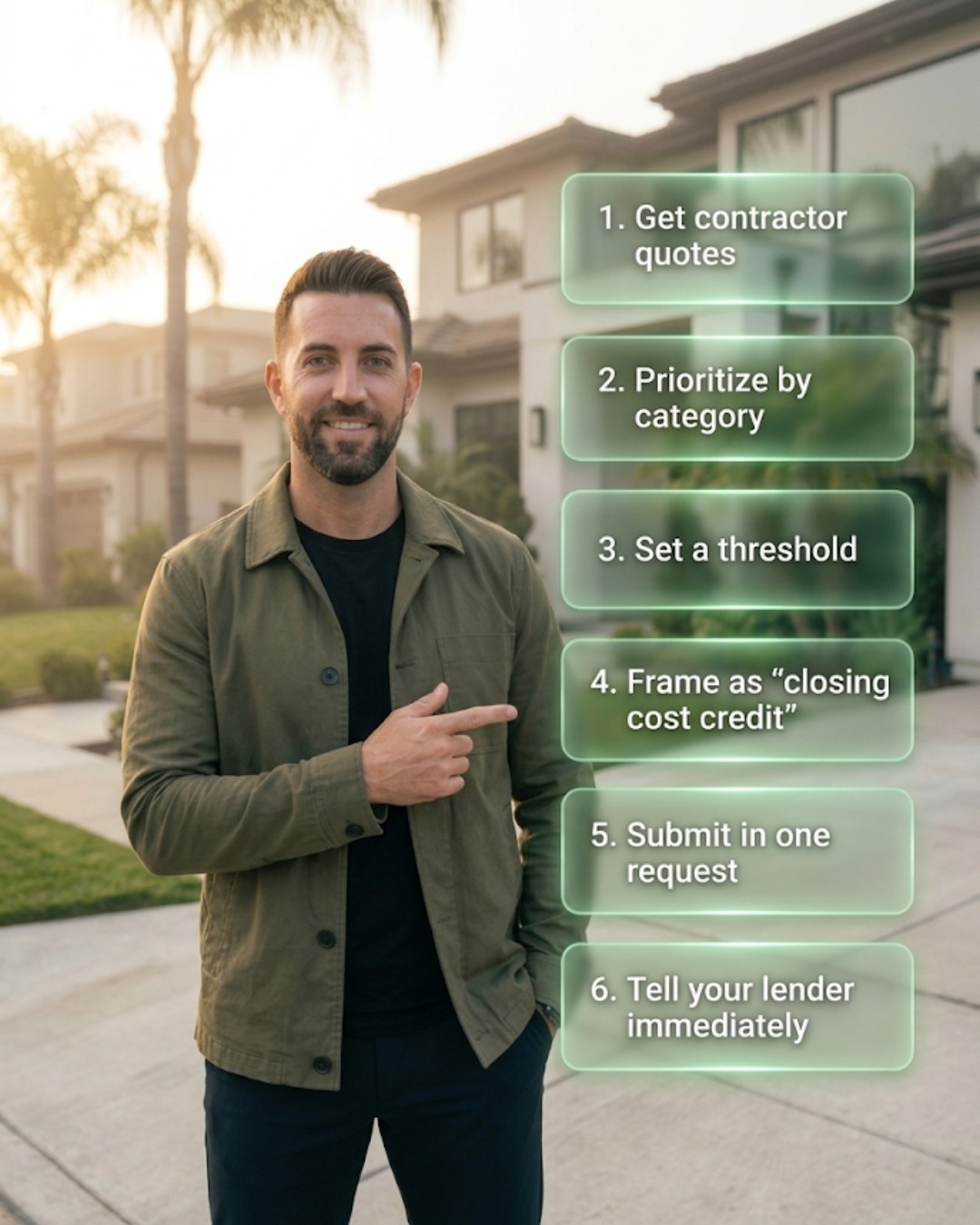
Detailed Steps
| Step | Action | Details |
|---|---|---|
| 1 | Get contractor quotes | For each major item, get a written estimate from a licensed California contractor. Do not rely on the inspector’s rough figures — lenders require actual quotes for any credit over $1,000. |
| 2 | Prioritize by category | Safety/habitability > Structural > Mechanical > Cosmetic. Lead with the issues the seller cannot reasonably argue against (roof, HVAC, sewer). Leave cosmetic items off — they weaken your position. |
| 3 | Set a threshold | Only request credits for items over $500–$1,000. Nitpicking minor items signals you are unreasonable and often causes sellers to dig in on everything. |
| 4 | Frame as “closing cost credit” | Never write “credit for roof repairs.” Write “credit toward buyer’s closing costs.” Repair-labeled credits require the lender to verify completion before funding — causing delays or denials. [G] |
| 5 | Submit in one request | Bundle all items into a single written request. Multiple rounds of requests signal inexperience and irritate sellers. One clean, documented ask is more likely to succeed. |
| 6 | Tell your lender immediately | Notify your lender as soon as a credit is agreed upon. Late disclosure can force last-minute restructuring of the entire transaction. Confirm total credits (seller + lender) don’t exceed your actual closing costs. [G] |
What Not to Request and Why
Every item you add to your seller credit request slightly reduces your chances of getting the important ones. Sellers and their agents have seen inspection reports before they know cosmetic issues from real problems. Lead with strength.
Just as important, some requests make your position stronger while others make it easier for the seller to say no.
Items that typically weaken your negotiation:
- Paint, carpet, and cosmetic flooring — unless severely deteriorated. Sellers view these as buyer taste preferences.
- Small plumbing drips and minor leaks under $200 — bundle these into a general credit rather than itemizing.
- Items the inspector flagged as “monitor” or “maintenance recommended” — these are not defects.
- Things you knew before making your offer — like a 1970s home with original windows. Sellers can reasonably argue this was priced accordingly.
Items that support strong requests:
- Active roof leaks or a roof within 5 years of end of life
- HVAC systems 15+ years old or showing active failure
- Any sewer line issue confirmed by camera inspection
- Safety hazards: faulty electrical panels (FPE, Zinsco), exposed wiring, GFCI absent near water
- Foundation issues confirmed by a structural engineer (not just the home inspector)
- Evidence of prior water intrusion or active moisture
- Missing seismic straps on water heater (California requirement [K])
California-Specific Inspection Issues
California homes have unique issues that affect credit requests. These are worth knowing before you go into negotiation:
Earthquake preparedness
- Water heater seismic strapping is required by California law (CA Health & Safety Code). A missing strap is a code violation, not just a recommendation, strong grounds for a credit. [K]
- Cripple walls (unbraced short foundation walls on older homes) are a seismic risk. Bracing kits cost $1,500–$4,500 and are highly negotiable post-inspection.
Fire risk and roofing
- In designated High Fire Hazard Severity Zones (HFHSZ), CA may require fire-resistant roofing materials (Class A). If the current roof doesn’t comply, you can request a credit for the upgrade premium.
- Check if the property is in a HFHSZ using the CAL FIRE map before your inspection. This affects insurance availability as well.
Geological hazards (required disclosures)
- Sellers must disclose if a property is in a Special Flood Hazard Area, Earthquake Fault Zone, Seismic Hazard Zone, Fire Hazard Severity Zone, or Wildland Urban Interface.
- These disclosures don’t automatically justify a credit, but they affect your cost of insurance and future resale. Factor them into your offer analysis.
Older homes
- Homes built before 1978 may have lead paint and asbestos. Lead paint disclosure is federally required. Asbestos in floor tiles or insulation may require licensed remediation at $1,500–$10,000+.
- Knob-and-tube wiring (pre-1950s) is still common in some Bay Area neighborhoods. Most insurers won’t cover homes with active knob-and-tube; this is a strong credit request.
Example: $1.1M San Jose Home
Here’s how a ficustree buyer can structure their post-inspection credit request on a 1978 San Jose home:
| Inspection Finding | Contractor Quote | Age / Proration | Credit Requested |
|---|---|---|---|
| Roof — 22-yr-old asphalt, active minor leak | $19,500 | At end of life | $19,500 (full credit) |
| HVAC — 16-yr-old AC, 14-yr-old furnace | $11,200 | Both past 15 yrs | $11,200 (full credit) |
| Water heater — 11 yrs old, no seismic strap | $1,400 | Near end of life + code issue | $1,400 (full credit) |
| Minor plumbing (2 leaks, 1 fixture) | $650 | N/A | $650 (bundled) |
| Interior paint (seller preference excluded) | $3,200 | Cosmetic only | $0 — not requested |
| TOTAL CREDIT REQUESTED | $32,750 | ||
| TOTAL CREDIT RECEIVED | (seller countered) | $26,500 |
The buyer excluded paint, framed the request as a single closing cost credit, and received $26,500, which is enough to cover all closing costs and fund the roof and HVAC replacements in the first year of ownership.
Have a question? Find answers here…
How long do I have to request seller credit after the inspection in California?
Your California Residential Purchase Agreement (RPA) specifies an inspection contingency period which is typically 17 days from acceptance. Within that window, you must request repairs or credits (or remove the contingency). Exact timelines vary by contract version and any addenda. Check your specific agreement or ask your agent.
Can I ask for a credit that exceeds my closing costs?
No. Even if the loan program allows a 6% seller contribution, the credit cannot exceed your actual closing costs. Any excess is forfeited and it does not reduce your loan balance or come back as cash. Structure your request to match your closing costs as closely as possible.
Should I get contractor quotes before submitting the credit request?
Yes, for any item over $1,000. Vague requests based on inspector estimates are easier for sellers to reject. A licensed contractor quote is harder to argue against and is often required by lenders for documentation of larger credits.
What if the seller refuses the credit entirely?
You have three options: accept the home as-is and budget for repairs yourself, negotiate a reduced price instead (which may be more palatable to the seller), or exercise your inspection contingency and exit the contract. Your agent and your risk tolerance should guide this decision.
Can I use the credit to buy down my interest rate?
Yes. If your closing costs are lower than the credit amount, you can constructively increase costs by funding a mortgage rate buydown (discount points). A 1-0 or 2-1 temporary buydown on a $700,000 loan typically costs $6,000–$14,000 and can be funded by a seller credit.
Do seller credits after inspection affect the purchase price?
No. The closing cost credit does not change the purchase price. The home still needs to appraise at the purchase price. If you ask the seller to reduce the price instead, that affects the loan amount and potentially the LTV.
Sources and Data
All repair cost ranges are sourced from published contractor data for California. Individual property repair costs vary significantly based on home size, age, location, material type, and access. Always obtain licensed contractor estimates for your specific home before requesting any credit.
Sources and Data
| Ref | Data point | Source |
|---|---|---|
| [A] | Roof replacement California average: $18,257 (2,495 sq ft asphalt shingle) | Instant Roofer, March 2026 |
| [B] | Roof replacement CA range: $12,000–$26,600 for 2,000 sq ft including labor | Modernize Fixr.com |
| [C] | HVAC replacement national average: $6,000–$15,000; CA higher due to labor rates | HVAC Calculator Hub, 2025 Airmaxx, Dec 2025 Angi, 2026 |
| [D] | HVAC systems: replace if 15+ years old or repair costs exceed 50% of new unit price | Angi HVAC guide Stewart Heating, 2025 |
| [E] | CA sewer line repair: $3,500–$6,500 spot; $6,500–$22,000 full replacement (2026) | Plumbing United, Feb 2026 FindEmergencyPlumber, 2025 |
| [F] | Repair cost ranges: foundation, electrical, plumbing, water heater | HomeLight Rocket Mortgage JVM Lending |
| [G] | Repair credits must be labeled as “closing cost credits” — not repair credits — or lender must verify completion before funding | JVM Lending |
| [H] | Seller concession caps: conventional 3–9% by LTV; FHA 6%; VA 4% + unlimited closing costs | Fannie Mae Selling Guide HUD 4000.1 VA Handbook M26-7 / VA guidance |
| [I] | Credits cannot exceed actual closing costs regardless of loan cap; lender + seller credits combined count toward limit | Fannie Mae Selling Guide B3-4.1-02 JVM Lending [G] |
| [J] | 80% of transactions involve some type of seller concession according to one agent; “Repair Threshold” approach recommended | HomeLight Raleigh Realty negotiation guide, 2025 |
| [K] | California requires water heaters to be strapped to prevent earthquake movement (CA Health & Safety Code) | CA Health & Safety Code CA seismic water heater bracing guidance |
Disclaimer
Educational purposes only, please conduct your own due diligence
Repair cost ranges are estimates based on California-wide published data and do not represent quotes for any specific property. Actual repair costs vary significantly by location, home size, material type, contractor, and property condition. Always obtain written estimates from at least two or three licensed California contractors before submitting any credit request to a seller.
Seller credit caps and contract requirements are based on federal agency guidelines current as of April 2026. Individual lenders may have stricter overlays. The “closing cost credit” vs “repair credit” language distinction is based on standard mortgage industry practice — verify the correct language with your specific lender before submitting your request to the seller.
California inspection timelines and contingency periods are based on the standard California Residential Purchase Agreement (RPA). Your specific contract terms may differ. This article is not legal, financial, mortgage, or real estate advice. Consult a licensed California real estate agent and mortgage professional before making decisions.